Waisak is an official holiday in Indonesia dedicated to the birth, enlightenment and passing of the Buddha. Indonesian Buddhists call it Tri Suci Waisak, the Three Holy Events of Waisak, because all three are remembered on one day.
It may come as a surprise that Waisak is celebrated in Indonesia at all. Less than 1% of the country’s people are Buddhist. Even so, the holiday is officially recognised and the whole country gets a day off.
The story behind the holiday
Buddhism began with one man, Siddhartha Gautama. He was born a prince, into a royal family.
As a child he showed kindness and care for every living being. From early childhood he was shielded from the sight of suffering. This was his father’s plan. A prophecy had warned that the young prince would leave the kingdom and choose a spiritual path, and the king wanted to prevent it. So he built his son a world without old age, illness or death. At least inside the palace walls.
The prophecy came true anyway. The tradition says that on trips outside the palace Siddhartha met four sights that changed his life: an old man, a sick man, a dead body and a wandering ascetic. He understood that suffering is part of every life and that no palace wall can keep it out. After that, the pleasures that used to delight him lost their taste. He left the kingdom and went out into the world to look for a way to free people from suffering.

Buddha statue at Borobudur Temple, Java. Photo: World Viewers Stop
For years he wandered as a homeless ascetic and kept looking for the answer to one question: how to put an end to suffering in the world.
Along the way Siddhartha joined a group of ascetic monks. They believed that harsh self-denial, pushed to the limit, would free the spirit. Many of them starved themselves. Siddhartha decided to try hunger too, hoping it would lead him to enlightenment.
He brought himself almost to death. Then he stopped the ascetic practice and began to eat normally again. The tradition remembers a young woman named Sujata who offered him rice cooked in milk. From this experience came one of the key ideas of Buddhism, the Middle Way: neither a life of luxury nor a life of self-torture leads to freedom. The prince had already tried the first. Now he had tried the second.
Soon after, Siddhartha sat down to meditate under a large tree, the one Buddhists now call the Bodhi tree, in Bodh Gaya in India. He cleared his mind and began to reflect on his life.
Through intense concentration he remembered his previous lives. He came to see that living beings are reborn again and again according to karma, the law that links every action to its consequences.
According to the traditional chronology accepted in Theravada Buddhism and in Indonesia, this happened in 588 BCE, on the full moon of the month of Vesak, called purnama sidhi in Indonesian. Many modern historians place the Buddha’s life about a century later, so the dates are a matter of tradition as much as of history.

Buddha statue at Brahma Vihara Arama, Bali. Photo: bejitour
Siddhartha understood that suffering comes from craving and attachment. He saw that when craving is gone, suffering is gone too.
With this understanding he reached enlightenment. He attained Nirvana and knew true peace.
For many years after that he shared what he had understood with the people he met across India. Soon he became known as the Buddha, the Awakened One.
At the age of 80 the Buddha passed away in Kusinara, entering parinirvana, final Nirvana. By the traditional chronology this was in 543 BCE. Birth, enlightenment and passing: three events, and the tradition places all three on the full moon of the same month. That is why one holiday remembers them all.
How Waisak became official
The decision to celebrate Vesak as the Buddha’s birthday across many countries was made at the first conference of the World Fellowship of Buddhists, held in Sri Lanka in 1950. Festivals at this time of year, however, had been a Buddhist tradition for centuries.
In its resolution, the conference thanked His Majesty the Maharaja of Nepal for making the full moon day of Vesak a public holiday in Nepal. It then asked the heads of government of every country with Buddhists, whether many or few, to make the full moon day of May a public holiday in honour of the Buddha, whom it called one of the greatest benefactors of humanity.
In Indonesia, Waisak became a national holiday by Presidential Decree No. 3 of 1983, signed on 19 January 1983. The same decree added one more holiday to the national calendar: Nyepi, the Balinese Day of Silence. So Bali’s quietest day and the Buddhist full moon entered the Indonesian calendar together, on one sheet of paper.
The name of the holiday comes from the Pali word vesākha, or Sanskrit vaiśākha. Vesākha is the name of a lunar month that falls in April and May of our Gregorian calendar. Because the month is lunar, the date moves, and in Indonesia Waisak can fall in May or June.
The holiday is associated with flowers, bright colours and trips to beautiful sacred places. On this day it is customary to release animals and birds. This is a symbol of liberation, which was the goal of the Buddha’s spiritual search.
The Buddha’s spiritual struggle, his progress toward his goal and his enlightenment are celebrated in many countries across Asia: Thailand, Singapore, Korea, Laos, Myanmar, Sri Lanka, Cambodia, India, Nepal, China, Malaysia, Vietnam and Indonesia. Customs and even dates differ. In Korea, for example, the Buddha’s birthday falls on the eighth day of the fourth lunar month.
In the temples
Shortly before dawn, Indonesian Buddhists gather at temples for ceremonies that honour the Buddha and his teaching. When the ceremony ends, Buddhist flags are raised and Buddhist hymns are sung.

Photo: kabarpadang
People bring flower offerings to the Buddha statues in the temples. A flower is a symbol of life. Flowers are beautiful, but they will wilt and die. This makes them a reminder that life is precious, and also of impermanence, one of the central ideas of Buddhism: everything that arises also passes. A fresh lotus on the altar says it more simply than any sermon.
Releasing animals
Many Buddhist monks release small animals from cages. This symbolises the Buddhist wish to free people from captivity and suffering.
Lanterns
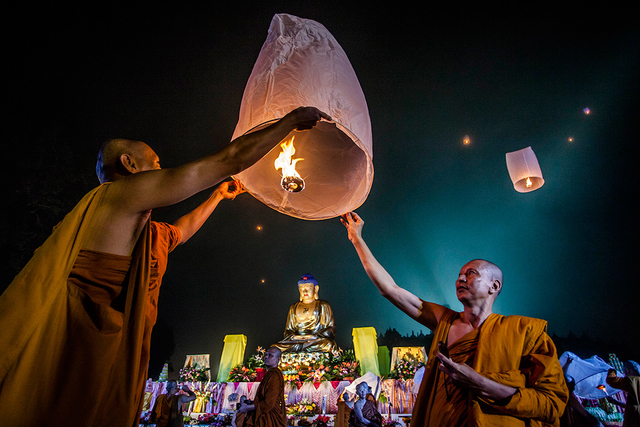
On the night of Waisak thousands of candle lanterns are released into the sky.

Photo: lifegate
Where to celebrate Waisak
In Indonesia the most popular place to celebrate Waisak is Borobudur. It is the largest Buddhist temple in the world and it hosts the national Waisak festival every year. Borobudur is also open to visitors who are not Buddhist.
The temple was built in the 8th and 9th centuries, under the Sailendra dynasty. It rises in nine stacked platforms and originally held 504 Buddha statues. On the upper circular terraces, 72 statues sit inside stupas of stone lattice, like Buddhas inside stone bells. In 1991 UNESCO listed it as a World Heritage Site.
Waisak and Borobudur have a long history together. The celebration at the temple was revived in 1953. When the great restoration began in 1973, the festival moved for a while to Mendut, a smaller temple nearby. Mendut still plays its part every year, as you will see.
Every year Buddhists from all over Indonesia make a pilgrimage to Borobudur. The faithful come to meet the temple’s monks, who gather for a meditation ceremony. During the meditation the monks chant mantras.

Photo: lifegate
Some pilgrims come from very far away, and on foot. In 2023, 32 monks walked to Borobudur from Nakhon Si Thammarat in Thailand. They set out on 23 March, crossed Thailand, Malaysia, Singapore and Indonesia, and covered about 2,600 kilometres. This walking pilgrimage is called thudong. Along the way, members of Muslim groups and soldiers joined them to keep them safe as they passed through their home towns. In a country where Buddhists are less than one percent, this may be the best illustration of what Waisak means in Indonesia. The pilgrimage has been repeated since then.

Photo: lifegate
During Waisak at Borobudur several rituals take place:
- Collecting blessed water at the Jumprit spring (Umbul Jumprit) in Temanggung, Central Java. Monks fill clay jars at the spring.
- Lighting torches from an eternal flame. The flame comes from Mrapen in Grobogan, Central Java, where a natural fire burns right out of the ground. Organisers explain the pair simply: water stands for coolness and a clear mind, fire for light and enlightenment.
- Pindapata, the offering of food to monks.
- Samadhi, deep meditation, at the very moment of the full moon. Every year the exact time of the full moon is announced in advance, down to the second, and thousands of people fall silent together.
Before the main day, the water and the fire are kept at Mendut Temple and blessed there. Then a long procession carries them about three kilometres from Mendut to Borobudur. So the elements of the festival travel too: from a mountain spring and a burning field to the largest Buddhist temple in the world.
A practical tip in the spirit of the Middle Way. The ceremonies are long, the crowds are big, and the moment of the full moon may come at an inconvenient hour. Bring water and something to eat. The Buddha himself tested starvation as a path to enlightenment and concluded that it does not work.
Besides the main ceremonies, Waisak is usually brightened up with parades and art events.
It is considered polite to leave a donation of food or money for the monks on Waisak.

Photo: beritadaerah
Waisak in Bali
Bali has several Buddhist and Chinese temples worth visiting on Buddha Day. Here are the most notable:
- Klenteng Ling Gwan Kiong in Singaraja, the old northern capital. It is one of the oldest Chinese temples on the island, built in 1873 by the old harbour. Like many Chinese temples in Indonesia, it follows Tri Dharma, the three teachings: Buddhism, Taoism and Confucianism.
- Brahma Vihara Arama in northern Bali, in the hills of Banjar. It is the largest Buddhist monastery in Bali, and its terraces will remind you of a small Borobudur.
- Vihara Dharma Giri in the hills of Pupuan, Tabanan, known for its giant reclining Buddha.
- Vihara Satya Dharma in Denpasar, by the entrance to the expressway. It is also a Tri Dharma temple.
- Vihara Buddha Dharma in Kuta.
- Vihara Buddha Guna on the Bukit, at Puja Mandala, the square of five houses of worship. Here a vihara, a mosque, a Hindu temple and two churches stand side by side. On Waisak it is a good place to see that Bali’s tolerance is more than a slogan on a postcard.
Waisak around the world
In Nepal, Buddhists from all over the world visit Lumbini, the Buddha’s birthplace, to pray in the temple.
In Thailand the holiday is called Visakha Bucha. In the evening people come to temples all over the country for wian thian, a candlelit procession. Holding a candle, incense and flowers, they walk three times clockwise around the temple hall: once for the Buddha, once for his teaching, the Dhamma, and once for the monastic community, the Sangha. The royal ceremony takes place at the Temple of the Emerald Buddha in the Grand Palace in Bangkok. If you are in Thailand on this day, do not plan a party: alcohol sales are banned across the country.
South Korean Buddhists decorate temples and shrines with colourful lanterns. During worship they also write their wishes and hang them on the lanterns. Korea’s lantern festival, Yeondeunghoe, is so old and so loved that in 2020 UNESCO added it to its list of the intangible cultural heritage of humanity. The festival begins by bathing a statue of the baby Buddha. UNESCO explains the lanterns as a symbol of lighting up the minds of people and of the whole society with the Buddha’s wisdom.
How to greet your friends
If you have Buddhist friends in Indonesia and want to congratulate them, you can say “Selamat Hari Raya Waisak” (Happy Waisak).
In a country where Buddhists are less than one percent, a greeting like this will be noticed. It costs nothing, and in the spirit of the holiday it is a small act of kindness to another living being.