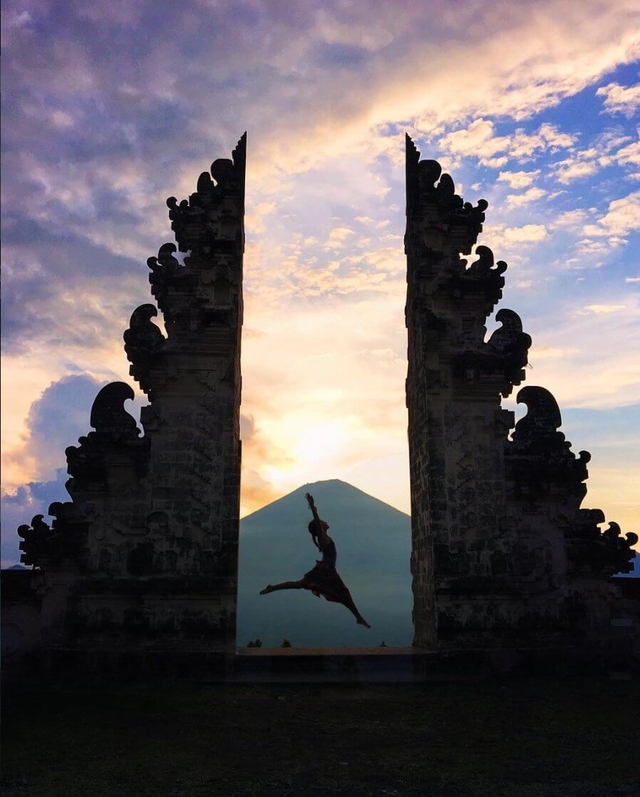
The split gate, candi bentar, is one of the most classic visual symbols of Bali.
Picture a small temple. Now picture someone cutting it in half with one clean vertical stroke and moving the halves apart, just enough for a person to walk through. That is a candi bentar. Two mirror halves, a gap between them, and the sky in the gap.
Candi bentar usually stand at the entrances to religious compounds, royal palaces and cemeteries. Lately, though, more and more secular places have been adding them to their architecture. Two bright examples are the entrance gate to the beach in Kuta and the gate of the Bali Handara golf resort.
The two halves are symmetrical and together repeat the silhouette of a Balinese temple. To pass through, you usually have to climb a few steps. You do not simply walk into a temple. You rise into it.
Such gates are found beyond Bali too: in Java, where the Majapahit dynasty once brought its culture to Bali from, and on Lombok.
A gate in many dialects
There are several styles of candi bentar. At one end are plain, smooth gates of red brick in the Majapahit style, found in Cirebon and Demak in Java. Then come the stucco-coated gates of Kaibon Palace in Banten, and the gates of Surakarta and Yogyakarta, also in Java. At the other end are the richly decorated gates of Balinese temples and palaces, where every centimetre of stone is carved.

Gate at Lempuyang Temple. Photo: @islandtravelbali
Candi bentar serve no defensive purpose. From the very start they were designed without doors. A gate you cannot close is a strange invention for a guard. For a temple it makes perfect sense.
What the split means
The symbolism of these gates is explained in different ways.
According to one version, the gates recall the sacred Mount Meru, split into two equal halves. Meru is the mythological mountain where the gods live. It appears in Hindu mythology and also in Jain and Buddhist stories.
Bali has its own continuation of this story. A popular legend says that when Mahameru, the seat of the gods, was carried to Bali, it split in two, and the halves became the island’s two great volcanoes, Agung and Batur. If you believe the legend, every time you pass through a candi bentar, you walk between two volcanoes.
According to another version, the two sides of the split gate stand for the Balinese idea of duality and the importance of keeping a balance between the dark and the light forces. The halves stay apart, and the person who walks through stands exactly in the middle, where the balance is.
Some cultural scholars believe candi bentar serve purely aesthetic purposes: to create a feeling of grandeur in front of the temple entrance. This version is the least romantic and the hardest to argue with. The feeling of grandeur works on everyone, believers and sceptics alike.
Two gates, two thresholds
The candi bentar, which has no lintel or arch on top, and the paduraksa, which is arched and has doors, are both essential parts of Balinese and Javanese temples. In Bali the paduraksa is also called kori agung, “the great door”.
Both kinds of gates separate spaces with different degrees of sacredness inside the temple. A candi bentar usually marks the border between the outside world and the outer courtyard of the temple, the nista mandala.
A paduraksa usually marks the border between the middle courtyard, the madya mandala, and the inner and most sacred one, the utama mandala.
One way to read this layout: the candi bentar is thought of as the foot of Mount Meru, so it is held in less reverence than the kori agung. You enter the mountain at its base, where everyone is welcome, and the higher you go, the more doors there are.

Paduraksa gate at Lempuyang Temple. Photo: wanderersandwarriors
Look up when you stand in front of a kori agung. Above the doorway there is often a carved head with bulging eyes and fangs. This is Bhoma, the guardian. He has only a head left, and he uses it to watch who comes in.
Balinese temples hold many rituals, and candi bentar often become a colourful backdrop for sacred dance ceremonies. Some dances are more sacred and are performed in the inner courtyard. Then the paduraksa becomes the visual centre of the ceremony.
And above all of this there is no roof. Balinese temples are open to the sky. The Balinese explain that during ceremonies the gods descend from the heavens into the temple and then return home. So the temple has doors for people and an open sky for the gods.
Where it all began
The tradition of building candi bentar is believed to have started around the 13th and 14th centuries, in the Hindu period of the great Javanese dynasties of Singhasari and Majapahit.
The split gate also left a portrait of itself in stone. A relief at the main temple of the Panataran complex in East Java shows walls, a small candi bentar and a watchtower. A gate carved into a temple wall, as if the architects wanted to keep a drawing of it for later.
The oldest surviving candi bentar was found by archaeologists in Trowulan, the ancient capital of the Majapahit dynasty. It is called Wringin Lawang, “the banyan tree gate”.

Wringin Lawang. Photo: kekunoan.com
Wringin Lawang is made of red brick. Its base measures 13 by 11 metres, and it rises 15.5 metres. The locals named it after a banyan that once grew next to it. In 1993 the tree was cut down because its roots were damaging the structure. So the gate lost its banyan and kept the name. Some locals believe it was the gate to the Majapahit palace. Others think it led into a residential compound of high-ranking people.
Time was not gentle with it either. Before the restoration of 1991 to 1995, the southern half still stood at its full height of 15.5 metres, while only nine metres were left of the northern one. For a while the oldest split gate was split in more ways than one.
The spread of candi bentar is linked to the influence of Majapahit aesthetics on Javanese and Balinese architecture.
A gate that crossed religions
Even after Islam spread across Java, candi bentar stayed in use.
The 16th-century Menara Kudus Mosque, one of the oldest mosques in Java, still has a candi bentar that marks the entrance to the mosque complex. The story of this mosque is a small lesson in Javanese history in itself. It was built in 1549 and named after the al-Aqsa Mosque in al-Quds, the Arabic name for Jerusalem. Its minaret looks like a red-brick Majapahit temple, and on top of it hangs a bedug, the great drum that calls people to prayer.
The Muslim cemetery complex of Sendang Duwur, in a village in East Java, has both a candi bentar and a paduraksa.

Menara Kudus Mosque. Photo: alif.id
Kingdoms changed, and religions changed. The gate kept its shape and went on doing its quiet job: dividing the outside world from the place where people pray.
A gate as a passport
Today the Indonesian government encourages the building of candi bentar as a form of regional identity.
The government of Banten, in Java, encourages building candi bentar modelled on the gates of Kaibon Palace, especially at entrances along the main road.
In the city of Cirebon, in West Java, red-brick candi bentar have become the city’s signature style.
Candi bentar also mark the entrances to many public buildings. One stands, for example, at Soekarno-Hatta International Airport in Jakarta. So for many travellers the first candi bentar of the trip appears right at the airport.
The gates of Bali worth the trip
Bali has more candi bentar than anyone can count. Some of them are especially grand, finely decorated and loved by tourists.
1. Lempuyang Temple (Pura Lempuyang)

Photo: @chelseakauai
Lempuyang Temple is one of the favourite spots of Instagrammers arriving on the island. If you want a photo of yourself in this gate, be ready to stand in line for several hours.
The highlight of this gate is the view of Mount Agung, which opens between the two halves of the candi bentar in clear weather. Remember the legend about Mahameru splitting into Agung and Batur. Here a real volcano stands in the gap of a gate that symbolises a split mountain. Even a sceptic has to admit the composition is good.
Now a confession on behalf of every photo you have seen. The famous reflection, where the gate and the volcano seem to stand over a still lake, is made with a small mirror. A local photographer holds it right under the lens of your phone. There is no lake. The only water at Lempuyang is the bottle in your backpack.
By the way, if you do not need the view of Agung and simply like the look of the gate, you can go around to the other side and photograph it from below without any queue.
2. Bali Handara Golf Club (Bali Handara Gate)

Photo: @tropicalislandidea
This gate marks the entrance to a golf resort in the mountains. Anyone used to be able to come here freely and for nothing. Once the gate became famous on Instagram, a manager was posted next to it to collect money for photos.
So the candi bentar, designed from the start without doors, finally got one. It is called a cash desk.
3. Besakih Temple (Pura Besakih)
Besakih is considered the main Hindu sanctuary of the island. Its candi bentar is very unusual and unlike any other in shape. You reach it by stairs and terraces, so the idea of rising into the temple becomes very literal here.

4. Kuta Beach

Photo: Debbie Gunn
This is the busiest and most popular beach on the island. Thousands of tourists pass through it every day.
The candi bentar looks especially impressive against the blue of the ocean and the waves breaking in the distance. Few gates of temple shape see so many swimsuits and surfboards pass through them.
Candi bentar have no doors, and that is their best feature. The gate does not ask who you are, what you believe in or what you came for. It only asks you to climb a few steps.