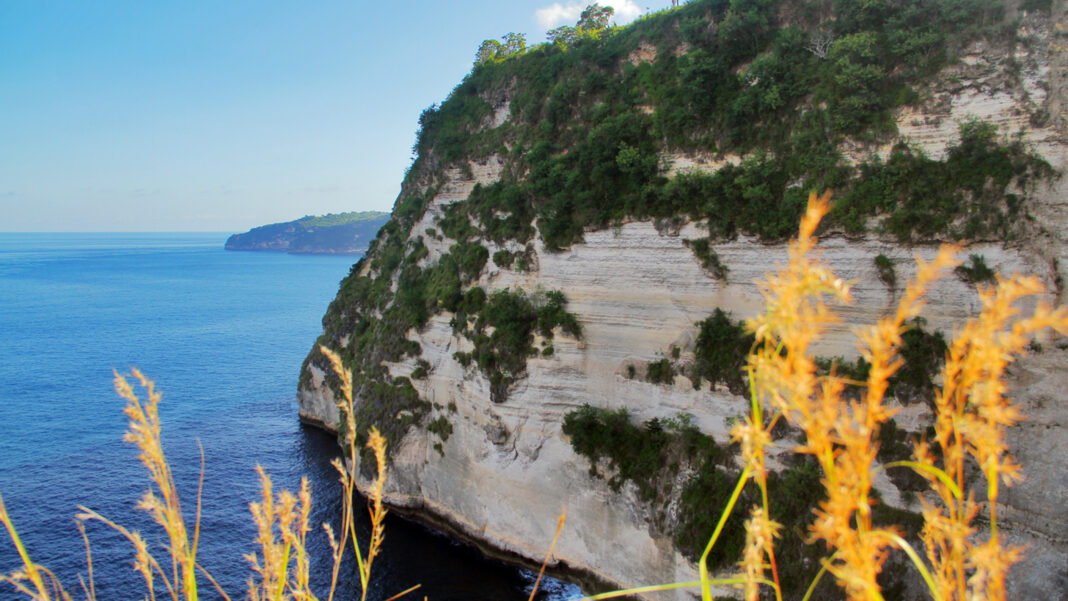
I did not plan this trip for long. The decision simply fell on my head.
I was doing a live stream with BaliForum’s followers, and a couple of times I was asked about the island of Nusa Penida. “Can you camp in tents on Nusa Penida?” “How many days should you spend on Nusa Penida?”
Without thinking, I blurted out: “Oh, I haven’t been there for a couple of years. Actually, I’m going this week, and then I’ll tell you everything.” Although I had no plans to go at all.
The stream ended, and I realised I was trapped. I do not like empty talk, and I am used to keeping my promises.
Before the story, a few words about where I was going, for those who have only seen Nusa Penida on Instagram. It is the biggest of the three Nusa islands that lie southeast of Bali, across the Badung Strait. Its two little sisters, Lembongan and Ceningan, sit right next to it. Penida belongs to Bali administratively and culturally, but it feels like a different planet: drier, rockier, emptier, with cliffs that drop straight into a sea of a colour that has no proper name. For a long time the Balinese themselves were in no hurry to go there. The island had a reputation, and I will come back to it, because I happened to sleep a few hundred metres from the heart of that reputation.
Day one. The ferry and Crystal Bay
So on Tuesday morning I was already racing on my old Honda Vario Techno 125 to Padang Bai, to the ferry crossing.
I got there by 11 in the morning, having found out online in advance that the timetable was floating, and nobody knew exactly in which waters it floated or where it was sailing to.
It turned out that the ferry left for Penida at 14:00 and came back from Penida to Bali at 11:00 in the morning. So a day trip to the island by ferry makes little sense: you actually arrive with only three or four hours left before sunset. Since not all the roads on Penida are good, in that time you will manage to reach one sight. Or lie around on the soft sand of Crystal Bay. And you have to leave the next morning, and you are unlikely to see much in the morning.

Photo: leramulina
There was not much to do at the harbour. There is nowhere to sit outside, unless you count the concrete parapet by the fence as a seat. Inside the terminal building it is stuffy and uncomfortable. And all the charging sockets were already occupied by Instagram and Facebook maniacs like me.
People sat on the parapet along the pier. Lots of backpackers, reading books, getting to know each other. The ferry to Penida was expected at the far pier. Before it, by the way, two ferries to Lombok left from different piers.
Balinese women vendors took advantage of the fact that people were bored and wanted to kill time somehow. They carried crisps, biscuits and more crisps along the waterfront, swaying slowly and gracefully with boxes and baskets of snacks on their heads.
The ferry cost 31,000 rupiah for a passenger ticket and 50,000 rupiah for a bike. These were the prices at the time of my trip. When I bought the bike ticket, they checked my licence and the bike’s registration certificate, the STNK. It was valid, although the tax payment date had passed three months earlier. But that caused no problems at all.
Boarding began at 13:30. The crew helped park the bikes tightly, side by side. The ferry was packed to the brim with trucks, and it seemed to me that if tourists in cars had arrived right at departure time, there would have been no room left for them.
On the middle deck there was a passenger area. Comfortable shade, a sea breeze and vendors with water and snacks.

Photo: leramulina
The ferry does not rock, and the hour-long crossing is very easy. After we set off, an Indonesian duo came into the passenger hall and very plaintively sang a couple of heart-rending songs in Bahasa. But since they only rended Indonesian hearts, the donations came much more readily from the locals.
At unloading, a truck driver was waiting for his turn. Apparently he had picked up a good joke somewhere about how the English phrase “excuse me” sounds a lot like “kiss me”. He walked among the passengers, locals and foreigners alike, saying “kiss me, kiss me” every few seconds. For the foreigners, a joke repeated more than twenty or thirty times no longer worked. But the Balinese splashed out good-natured laughter and lit up with snow-white smiles every single time they heard that “kiss me, kiss me”.

Photo: leramulina
From the port I went to check into a guesthouse in the little village of Ped. I deliberately chose the cheapest guesthouse with good reviews on Booking, to see whether you can travel on a budget without suffering from dirt, cockroaches and roosters crowing.
The Yuda guesthouse is by the road. A bright sign with its name, impossible to miss. A tired owner, who greeted her guest’s arrival with considerable indifference. I had the feeling she was not even aware of the booking, of the fact that someone was coming, for some number of nights.
The room itself turned out to be pleasant. Big, dry, well ventilated, no mould, with a clean bathroom. The downsides: a very weak light bulb that did not give enough light in the evening, and no wardrobe to hang clothes in.
The neighbour with golden fangs
I only learned later what kind of neighbourhood I had chosen. A short walk from my guesthouse stands Pura Dalem Penataran Ped, the most important temple on Nusa Penida and one of the most revered in all of Bali. It is connected with a figure the Balinese treat with great respect and a good deal of caution: Ida Ratu Gede Mas Mecaling.
The legend says that the last ruler of Nusa Penida, Dalem Bungkut, became after his death Ratu Gede Mas Mecaling, the Great Lord with golden fangs. In Balinese belief he is the ruler of the unseen world, the niskala, with power over natural forces, and he can test people with disasters and illness. For a long time the island was considered the source of disease and dark magic. Some Balinese still prefer not to say his name out loud.
That is why Pura Dalem Ped is so important. Balinese pilgrims come here from the whole island to pray for protection and safety, and the prayers move through several temples of the complex in a set order. So the island with a dark reputation has turned into a place where people come for protection from the very forces it was feared for. Very Balinese: you do not run from the power, you come to it with offerings and ask it to be kind.
I knew nothing of this when I was choosing the cheapest room on Booking. I was thinking about cockroaches.
The roads of Penida
I repacked and went out to grab a piece of Penida before sunset. The island’s roads leave you with mixed feelings. On the one hand, there is a perfectly smooth asphalt road, which sometimes narrows so that two cars can hardly pass. Here and there chunks of asphalt are missing at the edge. It runs around the island, in some places along the coast, in others much closer to the centre.
And then there are all the other roads, which it would be more logical to call directions sprinkled with stones.
Potholes, ruts, gullies, bumps, craters. This is no extract from a dictionary of synonyms for “holes”. This is the menu of extreme pleasures that Penida’s off-road tracks can offer. They lie in wait for travellers on the road to Angel’s Billabong and Broken Beach, to Kelingking Beach, to Peguyangan waterfall, and on one of the roads to Atuh Beach.
The road to Crystal Bay is excellent. Just before the beach there are a couple of fairly extreme downhill and uphill stretches, but thank God there is no gravel on them, and drivers go carefully.
Crystal Bay
Crystal Bay had become quite a settled and busy beach in the couple of years I had been away. Lots of sunbeds, huts with warungs where you can buy fried rice, fried noodles or grilled fish.

Photo: leramulina
On the beach there is a kiosk where you can rent snorkelling gear or book a trip to remote spots where you can see manta rays. A trip to Manta Bay and Crystal Bay cost 200,000 rupiah. Renting a mask, snorkel and fins cost 100,000 rupiah.
The mantas here are a real reason to come. Reef mantas gather year-round at the cleaning stations around Manta Point, where small fish pick the parasites off their huge wings, like a spa for giants. And from July to October Crystal Bay is famous for something even stranger: the mola mola, the ocean sunfish. It is a fish the size of a small car, which looks as if someone forgot to draw its back half. It lives deep, but in these months cold, nutrient-rich water rises from the depths of the strait, and the sunfish come up to the reef to be cleaned. Divers wait for this all year. Snorkellers, alas, usually see only the divers’ bubbles.
I sat on the beach and remembered how just two years earlier my boyfriend and I had been almost the only visitors, apart from a dozen other tourists and the warung staff.
Having lost that emptiness, the beach lost its magic for me. Or maybe I simply missed the chemistry that a Russian-British couple had brought to Penida a couple of years earlier, a couple who could only unclasp their arms and stop kissing for brief moments. For those two hours on Crystal Bay I felt as if some vital part of my body was missing. And the pristine calm that had surrounded Crystal Bay two years earlier.

Photo: leramulina
The sand on the beach is a mix of white and black volcanic sand. There are waves. And yet on the left side of the beach you can see parents snorkelling with their children.

Photo: leramulina
I would not say this particular beach is worth the trip to Penida. But if you are already here and do not want to drive to the back of beyond and climb down a steep staircase to a paradise beach, Crystal Bay is the better choice. At least for the sunset.

Photo: leramulina
In the evening I stopped at the Penida Colada restaurant, which Penida’s TripAdvisor was praising. An atmospheric place with a view of Bali. A hipster interior, and the tables by the water already taken. I ordered grilled fish fillet for 70,000, and half an hour later I came to a conclusion that was confirmed later too. Do not come here for culinary delights. The food is simple and ordinary. You will not get food poisoning, but you will not get a wow effect either. Look for it on Penida elsewhere.
Day two. The cave temple, Atuh Beach and the Teletubbies hills
I decided to go to the beach that looked the most fantastic in photos: Atuh Beach.

Photo: leramulina
A green island at the mouth of the bay with an angular stone arch. I chose the road to the beach along the east coast and was not wrong. The road was perfectly smooth and scenic. All the way along the coast, on the slope to the right, there were brand-new guesthouses with ocean views, just waiting for the tourists to come.
Goa Giri Putri
I sped past a temple in the rock in a stream of pleasure. And a couple of moments later reproach began to gnaw at me. How could I not visit something I still could not even picture in my imagination!
The road from the parking area went uphill. I groaned with displeasure, not realising this would be the easiest climb of all the ones ahead of me.
After about five minutes I reached the gate of a small temple courtyard. A priest was busy there. “Where is the entrance to the temple?” He did not answer. He just handed me a sealed plastic cup of drinking water branded “Holy” and pointed to the visitors’ and donations book. At the top of a fresh page was the name of some Indonesian and his donation of 100,000 rupiah. Even if it was true, such a tradition would be worth inventing: start each new page with a nice round sum to hint to visitors how much to give. I left 10,000 rupiah. The priest sighed sadly, but still brought me a bowl of holy water to bless me.
“Is this the entrance to the temple?”
“Where?”
“Here.”
“There is no entrance here.”
And then I began to understand that the narrow crack between the boulders in the inner courtyard was the entrance. I started squeezing in, bent over and still catching my backpack on the rocks. After about two metres the crack became a little roomier, then it began to widen. And a little further on it opened into a huge hall wrapped in half-darkness. The dim light comes from round lamps on stands. The silence is broken by the sound of water dripping from the ceiling and the hum of fans.
I did not realise at once that I was alone here. In this dark cave, where bats dart back and forth, and the only way in and out passes through the horror of birth. Strangely enough, I was not afraid in the cave itself. Fear usually catches up with me when I imagine an earthquake and what would happen to the mountain I have climbed or the dungeon I have gone down into.
It was very far-sighted to write my name in the visitors’ book. At least they will know whom to look for under the rubble.
Along the middle of the hall ran a mosaic stone path, leading to another hall with an altar above and low stone benches for worshippers. I did not go up to the altar. It would have made sense to go up if I had brought offerings to give to the gods. But I had come empty-handed.
It is funny that, for all my general lack of religion, in critical places like mountains or caves I try not to disturb the spirits by accident or make them angry. What if they exist whether I believe in them or not, and slip a slippery pebble under my feet that sends me flying into the abyss?
I stayed in the cave only a short while. I still had to get to Atuh Beach. I did not even walk around the whole cave, so I missed the third hall of the temple, from which, it turns out, there is a fairly wide exit.
Later, at home, I read about the place I had run through so quickly, and felt a little ashamed of my haste. The temple is called Goa Giri Putri, “the cave of the daughter of the hill”. It is the largest cave on Nusa Penida, about 262 metres long, and its entrance lies around 150 metres above sea level. Pilgrims pass through six places of prayer in a set order. One of them is a holy water station where Balinese perform melukat, ritual purification. And at the far end of the cave, after the Hindu shrines, there is a corner that looks like a Chinese temple, with red lanterns and an altar to Guan Yin, the goddess of mercy. People pray there for success in business and prosperity. So inside one Balinese mountain, Shiva’s family and a Chinese goddess share the same darkness and the same bats, and nobody seems to mind.
As for “the horror of birth”, I was apparently not the only one to feel it: everyone has to bow low to get in, and the crack opening into a vast hall is often read as a symbolic passage.
Atuh Beach
For another twenty minutes the road delighted me with sea views, and I kept reminding myself to watch the road and not the play of the waves and the views of Lombok on the horizon.
Then the road turned inland. A few kilometres later it turned toward the beach.

Photo: leramulina
I kept waiting for a catch, and almost did not get one. The disorganised dirt parking was free. And a path led down, a bit like the descent to Bingin Beach, only several times longer.
I was encouraged by the fact that on the way down I overtook a married couple of about fifty. And they were not even thinking of stopping. Well, if people like that are going down, I have no right to whine either.

Photo: leramulina
And the beach really was worth such a descent. White sand. A fantastic island in the bay opposite the beach, a palm grove. No plastic rubbish in the water, and astonishingly clear water.
The waves were playful and fairly strong. So you had to make an effort to get into the water carefully and out again. Diving under the breaking waves to get out to where they roll, playfully rocking you.

Photo: leramulina
The last time I came out of the water, a wave threw me onto the shore and dragged me across the sand on my backside, and this scrub was not the most useful or pleasant for it.
In the morning there are very few people on the beach. Most began to arrive after 10 or 11.
The water is not only clear but also very refreshing. As a woman at one of the cafés told me, you can snorkel near the arch and see fish. But I had heard many times that Penida is famous for its powerful currents, so I decided not to swim far out on a beach with no lifeguards, without a companion.
Four or five little cafés offer a modest choice of food. Fried rice and noodles for 20,000 to 25,000 rupiah. Grilled fish or squid for 50,000. According to reviews by Russian tourists, the fish is completely tasteless.
I ordered a coconut for 20,000, thinking you could not possibly spoil one. And I was wrong. A swarm of flies immediately descended on the coconut, and I had to chase them away every five seconds, otherwise they covered it and tried to get inside and become an extra ingredient of my lunch.
The waitress said that the staircase at the other end of the beach had more interesting views. No wonder. It was free of trees for most of its length, and I could see from the beach that tourists found it much easier to walk down than the one I had come by.
After swimming to my heart’s content, I headed for it. Where the civilised part of the beach ended, I came across a stretch with plastic bags, bottles and cups. The very ones that take part in the conspiracy “All the rubbish floats to Bali from Java. We have no rubbish here. It’s someone else’s.”
The climb was really very easy. The only thing that stopped me was that every couple of steps I wanted to stop and simply admire the views opening up: the airy blue, piercingly clear water of the bay, the cosmic arch and a sea of green, which entered me, intoxicated me and plunged me into euphoria. I was even wary of taking photos with the camera. It seemed to me that the view in the viewfinder was so alluring that I would take a couple of steps into the abyss without thinking, enchanted by the splendour of the landscape.

Photo: leramulina
At the top I found a warung with food and drinks, and a hill with views of the open sea. From there the arch and the islands were much better seen than from the hill where I had parked my bike. Lombok was visible on the horizon, and I spent a few minutes imagining my future travels around Lombok and climbing Rinjani.

Photo: leramulina
There was nothing much else to see. I went down to the beach and back up again to my parking spot. I drove a little further along the road toward the sea, hoping to find a viewpoint. There was none. But there were traces of roadworks, evidence that someone had once tried to build an access road to the beach from this side, and maybe in five years it will finally open.
The Teletubbies hills
I was so full of happiness after the beach that I did not particularly want to go anywhere. But according to the map, the Teletubbies hills were waiting for me on the way.
I had never watched that programme, but I had an idea of what its opening titles looked like, the ones the hills were named after. But if it is on the way, why not?!
My Telkomsel internet heroically supported me on Penida at every bend and descent. It caringly slipped me markers of the most interesting viewpoints and sights.
And after about twenty minutes of winding along a road with views that made me want to yell at the top of my lungs, “Penidaaaa! I love yooooou!”, my internet pointed me to a turn onto a country track. I did not have to ride long on the stony dirt road. It did not plunge or climb steeply. But on my left the magic of green hills unfolded, piling up one after another like in a cartoon and playing with shades of green in the shadows of fluffy clouds.

Photo: leramulina
Before the official spot marked on maps as Teletubbies Hill there are a couple of viewpoints. One just with a view, and another with a meadow criss-crossed with trodden paths. It is not scary to walk along them, because you feel sure you would see a snake basking in the sun.

Photo: leramulina
At the official viewpoint there were a few Balinese bikes. A romantic couple embraced chastely on the short grass. But the view from this point was not as good as from the first one. The hill right in the centre was overgrown with dark vegetation and looked out of harmony among the carefree bright green all around.
There is nothing special about this place. There is nothing in particular to do here, and you just want to be. To glide from side to side across the slopes of the emerald hills. To feel the gentle grass tickling your ankles, to turn your face to the breeze floating at the heights.
I let the beauty soak into me and let it bloom inside in unexpected scatterings of inspiration, smiles and kindness. When I had taken in so much that I could not wipe the blissful smile off my face, I rode home.
I followed a smooth little road, full of descents, though safe enough. Through quiet villages in the shade of green thickets and wild bushes of bright pink bougainvillea.
An island where birds are protected by village law
On that ride home I noticed how many birds there were around. I put it down to the countryside and the empty roads. Later I found out there was another reason, and I like it very much.
Nusa Penida, together with Lembongan and Ceningan, is a bird sanctuary. And it was created without fences and rangers. In 2006 every village on the islands, 35 of them at the time and 41 now, agreed to add bird protection to their awig-awig, the traditional village laws. These laws are decided by the whole community and are rooted in Hindu religious practice, so breaking them means going against your neighbours and your gods at once. The idea came from a Balinese veterinarian, Bayu Wirayudha, and his foundation, Friends of the National Parks Foundation. He wanted a safe home for the Bali starling, a snow-white bird with a blue mask around its eyes, which is found nowhere else in the world and was almost wiped out in the wild by poachers.
It worked. According to the foundation, the starling population on the islands has grown from fewer than ten birds to more than a hundred. Some former poachers now work as bird guides. A village law turned out to be stronger than a criminal code: a whole village watching you is a far more serious deterrent than a distant court.
So the next time you see a white bird with blue “glasses” flitting over the dry bushes of Penida, know that a whole island is guarding it. With its customs, its gods and its gossip.
Evening in Ped
In the evening I went to Warung Tu Pande, which was listed on TripAdvisor as “Number one on Penida”, and once again my opinion of the island’s eateries was confirmed. It feels as if visitors give most restaurants on Penida high scores less for the food and more for the waiters’ sugary smiles.
I booked a guesthouse for the next two days at about the same price as Yuda’s. But it had higher ratings for service, and the booking showed tempting information that the price had been reduced by 40% for me.
The bait worked. Besides, I was disappointed with the internet at Yuda’s guesthouse. It was enough for my phone. On my computer the internet was dead.
Day three. Kelingking Beach, Angel’s Billabong and Broken Beach
In the morning I packed my things and moved to a guesthouse 300 metres from mine. The courtyard was microscopic, tiled. The room was much smaller, the bathroom tiny. But the lamp in the room was brighter, there was a wardrobe to hang clothes in and a faster internet.
The cherry on the cake was the radiantly smiling guesthouse manager. Even if I had swapped one evil for another, this one was sweeter and gentler.
My plans for the day were Napoleonic. Kelingking Beach (ideally with the climb down the cliff to the untouched beach), Angel’s Billabong and Broken Beach. So I stopped by the road to have breakfast: nasi kuning, yellow rice with turmeric and all sorts of fish and vegetable goodies.
A foreign woman tucking into nasi kuning in a warung like that, and with her hands too, is a real show. Little groups of Balinese flocked around me, making easy small talk, into which, around the third or fourth question, they shamelessly slipped the inevitable: “Are you married?”
Luckily for me, during this conversation a local guard went up to my bike and checked the brakes. The right one sank without any resistance.
“Eeeeh! You can’t go to Broken Beach with brakes like that! You have to fix them. You won’t make it!”
Of course I knew I would not make it. But the eternal Russian “maybe it’ll be fine” kept postponing my plans to repair the brake, until a sensible adult reminded me that life is worth keeping for a while longer. That is how it always goes: you fuss over others and try to protect them from trouble with advice, and you think about your own safety last.
I spent the next half hour at a repair shop, paid 80,000 rupiah and set off to meet the monstrous roads.
I wandered along slopes bristling with stones, crawled down and up through holes and bumps. I got a puncture and had it fixed at a roadside tyre shop for 40,000 rupiah.
And suddenly I came out onto an imperturbably smooth road. As if the whole nightmare had never happened.
Penida has a strange thing. Sometimes the road is repaired right at the sight, at the place that brings in money, while most of the way there can be hellish. And this sudden smooth stretch is refined cunning. As if the road wants to tell you: “What slander is this, that the road to Kelingking is off-road with directions?! Look at me, I am fresh and beautiful. Stop your lies.”

Photo: leramulina
Kelingking
Kelingking Beach is a perfect illustration of how Instagram “made” a place. Clouds of users’ photos of the ridge sliding into the ocean like a dragon’s body exploded Instagram. Now it is as if you have not been to Penida unless you have taken a selfie like that. So in front of the selfie platform there is a queue of people wanting to tick the box on their “things to do in this life” list.

Photo: leramulina
Around it there are about a dozen warungs offering simple food and drinks. And also a chance to catch your breath for those who decide to go down to the beach after all.
I went down. From the ridge, the steps lead downhill toward the dragon’s head. The handrails are sticks three to five centimetres thick, tied with blue plastic string to the thin trees growing along the path.

Photo: leramulina
The “steps” are either cut into the rock, or, where the descent is very steep, they are the same kind of sticks tied to trees. Some sticks are worn out and tied in only one place, or they wobble. Up to the turn, it was not scary. Every now and then I met Instagrammers posing on one bend of the path or another.

Photo: leramulina
I reached the point where the path turned the other way and headed toward the beach. “Well, that’s nothing, I went down a path to a beach yesterday too,” I decided, and, looking forward to the secret beach, I moved on along the path.
The problem was that the path did not exactly turn the other way. It turned down. There were sections going sideways, but they alternated with ones that looked like a ladder up to an attic. Only in my case the attic was about 100 metres high, and there was certainly no soft mattress at the bottom.
About 50 metres further, I met an Indonesian guy on the path, sitting and staring at his phone. It was probably the strangest place for such an activity. Only a climber sending a selfie to Instagram while clinging to a vertical wall could beat him.
I do not know exactly what he was doing. Maybe he was trying to find an app in the App Store that helps stop panic attacks.
I went around him and kept going down. I believed less and less in the saving power of the twig handrails, and more and more often I thought I would not have the strength for the way back up, and then the bumpy road to Angel’s Billabong. And the funniest thing was that I began to feel that any moment now I would panic, I would be able to go neither down nor up, and I would sit there for a good half a day, clinging with trembling hands to a flimsy little tree.
I looked down at the handful of lucky people who had made it to the beach, running on the white sand and swimming in the perfect clear water, splashing, laughing.

Photo: leramulina
And 40 metres from the beach I realised I had no more motivation to go down, because my personal gains from the descent were outweighed by the losses. Of time, of strength. And by the realisation that if I slipped, fell and broke something, it would become one more headline in the series “Russian tourist chasing a selfie crashes at a popular resort”. And the comments would quite rightly mock me and my stupidity for all they were worth.

Photo: leramulina
I did not want to join that sad list, and I began to scramble back up. It was no easier. When I got back up to the platform for Insta photos, I just wanted to lie down flat on my back on the ground and not move for about half an hour.
I went into a warung, ordered a coconut, calmed my trembling knees and promised myself to go to a climbing gym, so that one day I could come back here.
The lift that never was
Since my trip, Kelingking has had a whole saga, and it fits this story too well to leave out. A company started building a glass lift down the cliff: a 182-metre elevator and a 64-metre bridge, so that tourists could ride down to the beach instead of crawling along sticks tied with string. The project was worth around 200 billion rupiah. For a year and a half the construction grew on the side of the famous cliff, and photos of a concrete tower next to the dragon went viral. People were furious that the most famous view on Penida was being ruined.
In November 2025 the governor of Bali, Wayan Koster, ordered all construction to stop and the developer to demolish the structures within six months. He explained it simply: if every attraction gets an elevator, even the climb up Mount Agung, what will be left of Bali?
As I write this, the story is still not over. The demolition deadline in May 2026 passed with the tower still standing, because the developer took the decision to court, and the project is officially frozen. So the dragon now has a stranger lying next to it, waiting for the judges.
I have mixed feelings about it. I am the person who gave up 40 metres from the beach, and a lift would have taken me there. But I promised myself a climbing gym, and I like the idea that some places must be earned with your own legs.
Broken Beach and Angel’s Billabong
Potholes, ruts, gullies, bumps, craters. This refrain sounded again on the road to Broken Beach and Angel’s Billabong. Broken Beach is called that for good reason. And a broken road comes with it as a free bonus and an extra adventure.
Every now and then I could also hear an English-speaking couple swearing next to me, showering each other with f-words and s-words while riding a bike. At one point they stopped, the girl got off the bike and pretended she was leaving the guy for good. And this was one of the worst possible places for such a whim. She might as well have walked out of a Russian Arctic station hut at night in a blizzard to show him her displeasure. Or jumped out of his boat into a crocodile-infested river to say, “That’s it. I’m leaving.” But wisdom won, they gathered up all their disagreements, got back on the bike and bounced on over the bumps.
The roads on Penida are very strange. If you check the travel time between sights on Google Maps, it will almost always show about an hour. Because nobody knows for sure whether you will get a flat, fall off and scrape yourself, or just crawl over the bumps at a snail’s pace, how many times this will happen and how long you will spend bandaging your knee and fixing your tyre. So the time is almost always about an hour, plus or minus an hour, probably.
At the parking area near Angel’s Billabong I paid 5,000 rupiah and followed the signs. Around the pool there is a very convenient cement path with wide steps. By the pool a crowd waits for the people taking photos to get out, so they can snap a photo for themselves.

Photo: leramulina
It looks more like an Insta-conveyor belt. But that says nothing bad about the place. It is magnificent. The sun’s rays, falling into the pool, set fire to the most incredible green and blue colours in its depths. And all this colourful madness is framed by the black peaks of the rocks, whose needles were carved by crashing ocean waves over millions of years.
The beauty here has a dark side, and I would feel wrong not to mention it. The “billabong” looks like a calm natural pool, but it is connected to the open ocean, and from time to time a big wave comes over the rocks without warning. Over the years several tourists have been swept out to sea here, and at least four have died: a honeymooner, a young man who tried to save his girlfriend, men taking selfies on the edge. After a series of tragedies on the island, local authorities at one point banned swimming at Angel’s Billabong, Kelingking and Diamond Beach altogether. So if you come, look at the pool from the path, watch the sea for a few minutes before you go near the edge, and never turn your back on the ocean. The best photo is the one you can post yourself.
Further on, the path went to Broken Beach, another Insta-attraction. There were fewer Instagrammers here, and fewer drone operators too. The only thing saving me from the sun was a wet sarong wrapped around my head.

Photo: leramulina

Photo: leramulina
After walking around the hills, I was so tired that I headed home. The way back was just as bumpy, but it changed its anger to mercy when I reached the crossroads with a statue, which connects the roads to Crystal Bay, to Broken Beach and to the civilised areas of Toya Pakeh and Ped.
Day four. The Segara Kidul temple and the tree house
I decided to dedicate the last day of my trip to the temple that sits right by Peguyangan waterfall, under the cliff. The road was not the best. But it was somewhere between the horror of the road to Angel’s Billabong and the perfection of the road to Crystal Bay. I endured this test without complaining any more.
Parking at the temple cost 5,000 rupiah. For 5,000 they also rent out sarongs, because you have to make the whole way down in a sarong. The staircase is also part of the temple. As for the top, European women are even allowed vests. Nobody is strict about covered shoulders here, because the descent is hard and it will definitely be hot. You do not need to take drinking water down, but it is better to take an empty bottle to collect holy water from the springs, if you are interested and believe in its miraculous powers.

Photo: leramulina
Blue metal steps lead down. They do not wobble and look reliable. In some places the staircase is gentler, in others steeper. It is a bit scary when you have to climb over the water pipe that carries water from the waterfall up the mountain.
Later I counted it out of curiosity in other people’s reviews: the blue staircase has more than 700 steps. Every one of them you will remember on the way up.

Photo: leramulina
It is also a bit scary on the last stretch, just before the temple, because 30 to 40 metres below the staircase the waves are raging, and you walk right above them.

Photo: leramulina

Photo: leramulina
Pura Segara Kidul
Beyond the staircase begins a platform under the cliff, where the temple stands. The temple is very simple. A candi bentar split gate, a statue of the goddess of the southern sea, an altar to Sang Hyang Widhi Wasa, the supreme god of the Balinese, a statue of Ganesha, and several springs of holy water.
The temple is called Pura Segara Kidul, the temple of the southern sea. Balinese come here for melukat, ritual purification with the water of the springs that flow out of the cliff.

Photo: leramulina

Photo: leramulina
The waterfall as such is not very impressive. But the atmosphere of peace and unity with the ocean is what gives rise to the strongest emotions.
I came down when two couples of travellers had gone into the temple ahead of me. I took off my sandals, because they seemed slippery, and walked on the stones barefoot, to feel the surface better and not slip. To be honest, this is a bad strategy, because the stones are sharp and dig into your feet, and to avoid hurting yourself you have to walk very slowly and feel each stone before putting your weight on it.
After 100 to 150 metres the temple grounds end and the bathing area begins. There you can take off your clothes, stay in your swimsuit and go down slippery steps, with water running over them, to a pool by the ocean. The incoming waves crash against the rocks and shower the person bathing in the little pool with a cloud of spray.

Photo: leramulina
I was on Penida between the full moon and the new moon, and the waves were weak. I suspect that on days when the waves are strong, bathing in this pool tickles your nerves. While I was there, an American sat down on the viewing terrace by the pool, gazing nonchalantly into the distance for a photo. But at the sight of an approaching wave he urgently fled into the pool so as not to be washed into the ocean.
If you are planning to go now, check first. In early 2026 there was a landslide here, and the natural pools at the foot of the cliff were closed to visitors. The ocean keeps reminding us whose territory this really is.
This temple is a place where you want to stay longer, and the climb ahead has little to do with it. Here you are filled with the power of the waves and the mighty rocks hanging overhead, and every now and then you bend down to the springs to drink pure, sweet water.
I regretted not buying little baskets of offerings for the spirits. It is not that I fiercely believe in all the Balinese ceremonies and perform all the rituals. It seems to me that if you come to a place and immerse yourself in what the people who live there do, you can come at least a little closer to the worldview of those who created these temples.
Whose idea was it to build a temple under a 200-metre cliff, when many centuries ago there was not only no road here, but no way to make a safe path down? How did people build all these staircases when they could not yet make strong metal steps? What force drove them in this risky undertaking? Did they bring the materials for the temple by boat and unload them onto the shore, or lower them from above, walking those 200 metres on foot?
I understood that asking the three gatekeepers at the top of the temple about this was pointless. They were in the usual all-Balinese meditative state, when nothing disturbs a person and any question is perceived as a ripple of the mind. So I kept these questions to myself, to tickle my mind and keep it from dozing off.

Photo: leramulina
The way back, strangely enough, turned out to be more nerve-racking. When you climb back up, you see the steps of the old staircase, which, according to the temple gatekeepers, had been replaced only six months earlier. And I would very much not have wanted to be on it six months earlier. The rusted, rotten supports of the old staircase loom before your eyes, you see what the current staircase is resting on, and you want to look away, the way sensitive people look away at the sight of an injection or a wound.
The second road to Atuh and the tree house
I still had half a day left. And I decided to spend it on the second road to Atuh Beach. The one that led to the pretty steps and the beautiful views of the beach. But judging by information online, the situation was ambiguous. Either you take a good road but go down bad steps. Or you take a bad road, see two magnificent viewpoints and go down good steps.
And so it turned out. I thought I was already a seasoned Nusa Penida hand and no road could get to me, but the road was full of bumps. And about 150 metres before the parking area, the concrete road dropped sharply down and then rose just as sharply up. And I realised I simply would not get through this section, up or down. So I left the bike and walked.
At the top, near the beach, a payment post was waiting for me, where you had to pay 15,000 rupiah. I had not paid it two days earlier, because I had come from the beach and had not passed this post. But I had already been on this side, so I went back to my bike and decided to ride to the turn-off to the tree house. Especially since it was only about five minutes away.
The tree house is three wooden cottages. They stand on tree trunks on a tiny peninsula.

Photo: leramulina
The descent is about 100 to 150 metres down. To live in them, you need both determination and stamina. And readiness to put up with the plumbing inconveniences of a separate shared outbuilding some distance from the cottages.
But most tourists come just to take photos on the steps, creating the illusion that they live in these tree houses. Having quit their office jobs and their measured lives, and carrying out the slogan of all the world’s Instagrammers: “Living the dream.”

Photo: leramulina
I was more interested in the gazebo on the hill behind the cottages. I walked up to it and accidentally scared off an Indonesian couple who were canoodling in this picturesque spot.
I sat down in the shade and simply began to feel, simply to take in what I saw. I was not meditating. I was simply saying goodbye to Penida. The next day I had a ferry at 11:00 that would take me back to Bali. And now I was looking at the last majestic face of Penida I could meet on this trip.

Photo: leramulina
Nusa Penida gave me many deep and strong emotions on this journey. It helped me say goodbye to my fear that I am supposedly not tough enough, to my worry that I could not ride extreme roads alone. It gave me so much beauty that I will cherish in my heart for a long time. It gave me the wish to train at a climbing gym and one day come back to Kelingking Beach stronger and ready for the extreme descent.

Photo: leramulina
A chronicle written by the sea
All around me rose giant, mighty cliffs with alternating layers of rock. For a moment I regretted that I had only skimmed a university geology textbook once. Just as we read the age of a tree by its rings, the history of Penida could be read in these layers. I imagined that somewhere I would see traces of an ice age, somewhere a volcanic eruption that left a dark stripe on this layered page.

Photo: leramulina
Back home, I opened what I should have read before, and the truth turned out to be even more beautiful than my fantasy. These cliffs are mostly limestone, and limestone is made by the sea. The pages I was looking at were written by corals, shells and tiny sea creatures that lived and died on an ancient reef millions of years ago, layer upon layer. Then the earth slowly lifted this seabed out of the water, and the sea that had built it began to carve it. Every arch, every pool, every dragon on Penida is the ocean reshaping its own old work.
And the ice ages did leave their mark, only somewhere else: in the water. During the glacial periods so much water was locked in ice that the sea level dropped, and geologists believe land bridges may have joined Nusa Penida with Bali and Lombok, so that animals could walk across. The strait I had crossed on a ferry full of trucks was once, perhaps, a path for some ancient creature.

Photo: leramulina
Before me lay a chronicle not only of the island of Nusa Penida but of the growth and maturing of our whole Earth. On this very cliff I was looking at lines written long before humans appeared on our planet, and perhaps even before today’s animals.
I felt like a tiny grain of sand, whose problems and fuss are nothing compared with the history of the world. And at the same time I felt an incredible strength, which Penida had shared with me and of which I was a part too.
You are that
In moments like this you understand better, and feel more deeply, why Hinduism, the religion of Bali, speaks to so many people. And one of its great sayings comes to mind: “You are that.”
In Sanskrit it is Tat tvam asi. It comes from the Chandogya Upanishad, one of the oldest philosophical texts of India, and it is one of the four “great sayings” of the Upanishads. In the text, a sage named Uddalaka teaches his son Shvetaketu. The young man has come back from years of study proud of his learning, and his father asks him whether he has learned the one thing through which everything else becomes known. Then, lesson after lesson, he repeats the same refrain: tat tvam asi, you are that.
My favourite of these lessons is about salt. Uddalaka tells his son to drop a lump of salt into a bowl of water and bring it back in the morning. “Where is the salt?” asks the father. The son looks and cannot find it: it has dissolved. “Taste the water from the top.” Salty. “From the middle.” Salty. “From the bottom.” Salty. You cannot see it, says the father, but it is everywhere in the water. In the same way, the finest essence that you cannot see is present in everything that exists. That is the truth. That is the Self. And you are that, Shvetaketu.
I was sitting above the ocean, and the ocean was salty from the top, from the middle and from the bottom.
In the philosophy of Advaita Vedanta, this saying is read in its boldest form. Atman, the true self of each person, is identical to Brahman, the universal soul, the foundation of being and the spiritual source from which the whole world arises. You (yes, you too, my reader!) are, in this reading, a part of the divine whole, and in the end one with it. Other Hindu schools understand the words differently and keep a distance between the soul and God, so it is fair to call this one interpretation among several. But it is the one that came to me on that cliff.
For people of Western culture, “you are that” is a puzzle. We tend to wave it away as an exaggeration or even blasphemy. It is hard for us to understand it or to get inside it. The teachers of Vedanta warn that it should not be read as “I am God” in the sense of the ego swelling to divine size. It works the other way round: the little “I” that frets, counts money and is afraid of Kelingking’s stairs is exactly what dissolves, like salt.
God, in this view, has two aspects. There is the outer circle, which is everything that exists. And there is the inner centre, which is you, your true self. It is whole inside you, as your true being and your essence.
In Bali, Tat twam asi sounds more down to earth. Balinese Hindus learn it as a teaching about the equal dignity of people and about brotherhood: I am you, and you are me. If the same essence lives in everyone, then hurting another is hurting yourself, and helping another is helping yourself. Perhaps this is where the Balinese patience comes from, the patience I had seen all week. The guard who checked a stranger’s brakes. The truck driver who made a whole ferry laugh twenty times with one joke. A whole island of villages who agreed to guard a small white bird.
And as it turned out on my trip, to experience this merging you can simply take a ferry, come to Penida, pay for parking and an entrance ticket, walk down to a gazebo on a cliff and open your heart.
And then sit looking into the distance, feeling the history, energy and life of our Universe rushing through you. And everything your eyes touch is you as well.
Afterword: what has changed since my trip
I wrote this story a few years ago, and Penida has kept moving since then. If you are planning to follow in my footsteps, here is what to know.
- Prices. All the prices in this text are from the time of my trip. Expect today’s ferries, parking, snorkelling and food to cost more, and use my numbers only as a guide to proportions.
- How to get there. Besides the public ferry from Padang Bai, fast boats from Sanur reach Penida in about 45 minutes. A day trip still makes little sense: the island deserves at least two or three days.
- Kelingking. The glass lift has been ordered to be demolished, but as of my writing it is still standing on the cliff while the court case goes on. The path down is the same kind of adventure.
- Swimming. At Angel’s Billabong, Kelingking and Diamond Beach, check the current rules on the spot. After several deaths, swimming there has been banned at times.
- Peguyangan. After a landslide in early 2026, the natural pools at the foot of the blue staircase were closed. Check before you go.
And keep the most important rule of Penida: the roads take about an hour, plus or minus an hour. Leave room in your plans for a flat tyre, a broken brake and a conversation about whether you are married.