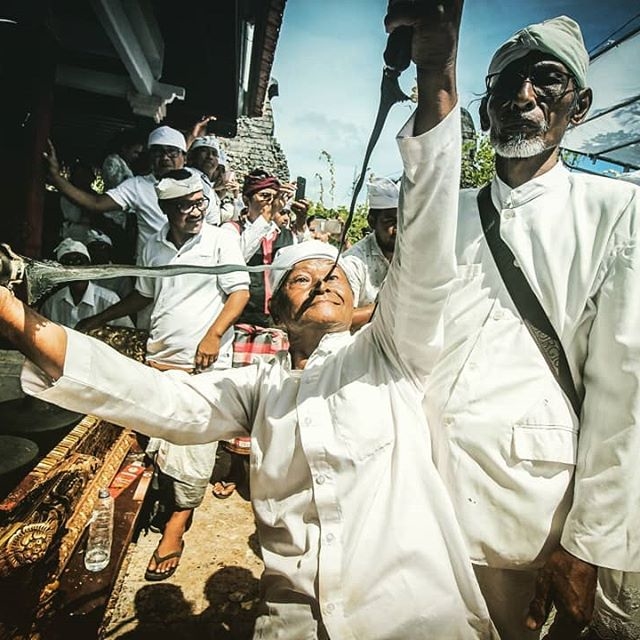
The name Ngurek comes from the word urek, which means “to make a hole” or “to pierce”. The name is honest about what happens.
The ritual is performed with a kris, a sharp traditional dagger. The performer presses its point to his chest, shoulders, neck, forehead, eyes and eyebrows and drives it in with a twisting, drilling motion. The body stays unharmed. Sometimes a spear is used instead of a kris.

Photo: @waskitanandangurah
The performers explain it simply. During Ngurek, spirits fill the body. As long as a person is in trance, no harm can come to it.
You may also hear another name for this ritual: Ngunying.

Photo: @kadek_ulong_art
Meet the main character
Before we go further, the dagger deserves an introduction of its own. In this story it is more than a prop.
The kris is an asymmetrical dagger. Its blade is narrow, its base is wide, and very often the blade runs in waves, like a snake gliding through water. The earliest known krises date back to the tenth century. Most likely they spread from Java across the whole of Southeast Asia. In 2008 UNESCO inscribed the Indonesian kris on its list of the intangible cultural heritage of humanity and described it as both a weapon and a spiritual object believed to possess magical powers.
A real kris is made by an empu, a master smith. He forges the blade from layers of different iron ores and meteorite nickel. In the best blades the metal is folded dozens or even hundreds of times. The layers leave a pattern on the steel called pamor, and there are about 120 kinds of it. So every good kris carries a little piece of the sky inside.
In Bali a finished kris goes through a pasupati ceremony. It is believed that this is the moment when the blade receives its power. Old legends go further. They tell of krises that move on their own and stand upright when the owner calls their true name.
Every 210 days Bali celebrates Tumpek Landep. Landep means “sharp”. On this day families clean their heirloom krises, place offerings before them and pray to Sang Hyang Pasupati. In the old days this holiday belonged to weapons: krises, spears, swords. Today the blessing has spread to everything made of metal, from cars and motorbikes to computers. So the kris has a very large family now, and your rental scooter is a distant relative.
One more detail I love. The word keris most likely comes from the Old Javanese ngiris, “to slice”. Put it next to urek, “to pierce”, and you get a ritual whose name and whose main tool both speak of cutting. And yet the whole point of Ngurek is that nothing gets cut.
Where it came from
The ritual dates back to ancient times. It appeared as a way for warriors to show their superiority and to express their gratitude to Ida Sang Hyang Widhi Wasa, the supreme god of the Balinese.
The legend tells of a Balinese king who decided to hold a procession to thank the supreme god. The ceremony opened with cockfights and dances, with music playing all along. When the celebration reached its peak, the warriors fell into a trance, drew their krises and began stabbing themselves in the chest.

Photo: @helopejati
If you have been to a Barong show in Bali, this scene may look familiar. The same gesture lives in the dance drama Calonarang. There the witch Rangda uses her magic to control the world, and Barong, the king of the spirits and the guardian of good, comes out against her. Men with krises fight, and when Barong appears, they turn the daggers on themselves. Barong protects them, and in the end holy water brings the men back from trance.
You can watch this story in Batubulan in Gianyar, where it is performed for tourists, and in Kesiman in Denpasar. Remember the name Kesiman. We will come back to it.
Three stages
Ngurek has three stages.
Nusdus. The performers enter trance through the sweet smoke of burning cendana, sandalwood. The smoke helps the process along.
Masolah. The performers dance in trance to the gamelan, the Balinese orchestra of gongs and metallophones.
Ngaluwur. The performers come out of trance and return to their ordinary state.

Photo: KulKulBali.co
As a rule, the performers in trance leave the inner courtyard of the temple and walk in circles around the wantilan, the temple’s open-sided pavilion.
Who may perform it
It is believed that only a person who has reached the heights of spiritual awareness can perform this ritual. He must be pure in body and in spirit. No weekend workshop will get you there.
Performers say that when they enter trance, they feel as if someone is guiding their hand. Every movement is beyond their control.

Photo: Mongabay
The Balinese believe the spirit has entered when the performer’s body starts to shake and tremble. Gamelan plays through the whole performance. For a long time the performers keep trying to pierce themselves, moaning and crying out. And where the kris meets the body, there are no wounds and no scratches.

Photo: Wak Laba
The ritual ends when a priest comes up to the performer, takes the dagger away and sprinkles him with holy water.
Where to see it
This extreme ritual is widespread in Bali. It is usually performed on holidays or during certain ceremonies. The most spectacular of them takes place in Denpasar, at Petilan Temple (Pura Agung Petilan) in Kesiman, and is called Pengerebongan. Yes, that same Kesiman.
The festival is also called Ngerebong. The name is said to come from two words: ngerehan, calling on a supernatural power, and bengong, amazement. The first half describes what the participants do. The second half describes your face as a spectator.
Pengerebongan is held every 210 days, which is one year of the Balinese calendar. To be exact, eight days after Kuningan, the holiday that closes the Galungan festive period. Galungan and Kuningan celebrate the victory of dharma over adharma, of order over chaos. The myth says that in dark times the god Indra led the gods into battle against Mayadanawa, the demon of illusion, and destroyed him and his army. That victory is what Bali celebrates at Galungan. Eight days after Kuningan, the people of Kesiman believe, the gods and goddesses gather at Petilan Temple to show their magical power to people and spirits, to protect people from danger and to drive evil spirits away.
The gods get help with the journey. Holy statues are carried to Petilan from all the temples of Kesiman and the neighbouring areas. Rows of tall penjor, decorated bamboo poles, stand in front of the temple. Crowds get so dense that the pecalang, the Balinese village guards, sometimes close the streets around it.

Photo: Wak Laba
Then the movement begins. Barong, Rangda and the pepatih, the performers, come out through the great temple gate and walk around the wantilan three times counterclockwise. This circling is called prasawya, and it is believed to weaken the demonic side of a person. It is during this circling that the pepatih perform ngurek. Then the participants walk around the wantilan three more times, now clockwise. This is pradaksina, and it is believed to strengthen the divine side. The three rounds stand for rising through the three worlds: Bhur, Bhuwah and Swah. First you unwind the demonic. Then you wind up the divine. Balinese cosmology has a precise sense of direction.
Not everyone in trance takes up a kris. Some women lose consciousness, while men dance and shout. The kris is only one of the ways a spirit makes itself known.
The temple fills with people, foreigners among them, drawn by Bali’s unique ceremonies. If you have traditional Balinese ceremonial clothing, you can come and watch this unique event.
A practical note. The Balinese year has 210 days, so Pengerebongan moves around the ordinary calendar and falls on a different date each time. Look up the date of Kuningan, count eight days forward, and you have your Sunday.
Just remember the second half of the performers’ rule: no harm comes to the body while the person is in trance. A sarong and a sash will get you into the temple. They will not get you into trance.