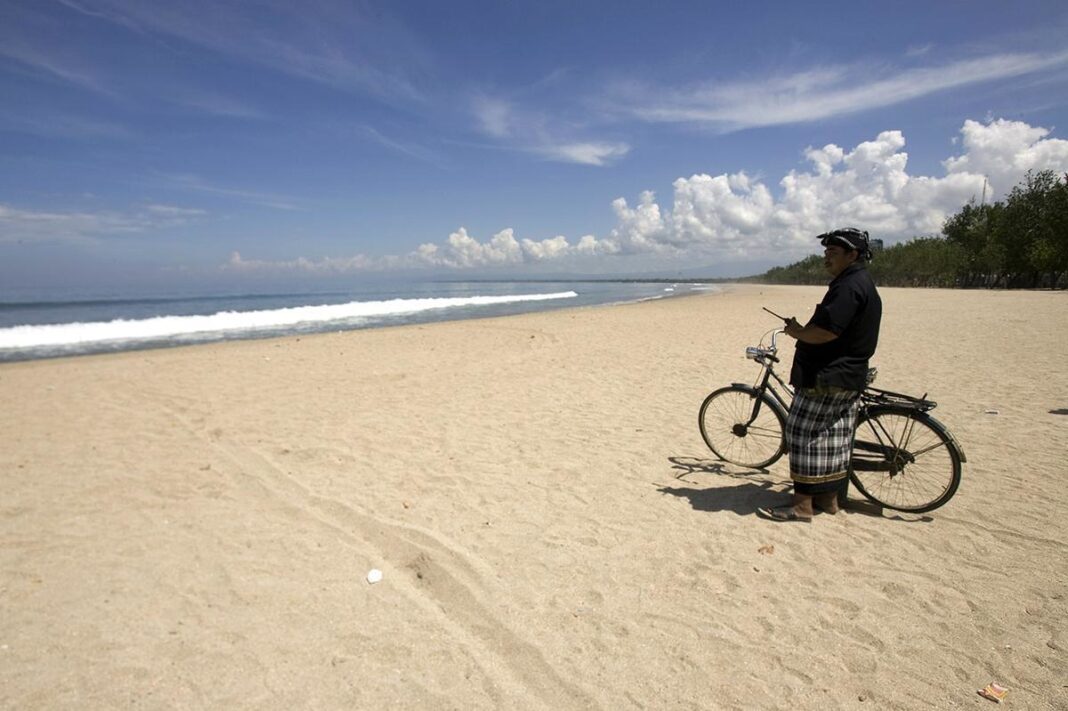
Imagine a holiday when almost nothing happens. People do not go outside, do not drive anywhere, do not dance or listen to music, do not turn on the lights, and some do not even eat or speak. This is Nyepi, the Balinese New Year. As you can already tell, it is a very unusual holiday.
Most of the world greets the new year with fireworks. Bali greets it by switching itself off. For twenty-four hours an island of more than four million people and millions of visitors goes quiet, and you can hear things you forgot existed: a gecko on the wall, a rooster three houses away, the sea.
The history of Nyepi
Nyepi is not the island’s only new year. It is the new year of one of the Balinese calendars, the Saka calendar. According to legend, Aji Saka brought this calendar from India and became the first king of Java. The Saka era began in 78 CE, so the Saka year is always 78 years behind the Gregorian one. Nyepi on 8 March 2027 will open the year 1949.
Bali lives by two calendars at once. One is the 210-day pawukon, which sets the dates of most temple festivals. The other is the lunar Saka calendar with its twelve months, or sasih. Each month begins the day after the new moon, which the Balinese call tilem. Nyepi falls on the first day of the tenth month, Kedasa, right after the new moon of the ninth month, Kesanga. That is why the holiday has no fixed date in the Gregorian calendar. It usually falls in March, close to the spring equinox.
In India, too, many Hindus celebrate a new year around this time of spring. It goes by different names: Cheti Chand, Gudi Padwa, Ugadi. But the Balinese New Year is unique and unlike any of them. Bali’s stands apart because it is celebrated in silence.
Melasti
The first important day of the Nyepi festivities is Melasti, also called Melis. It is usually held three days before Nyepi, but the exact date is up to each village. If the local council decides so, Melasti can take place anywhere from one to five days before Nyepi.
On the seashore, at holy springs, by rivers and lakes, Balinese people dressed in white walk in processions with decorated bamboo poles, the penjor, and Balinese ceremonial umbrellas. If you see a white river of people flowing toward the beach with gold and white parasols above it, you are watching Melasti.

Melasti. Photo: Gde Agung/Reuters
They purify the sacred objects that belong to the temples: arca, pratima and pralingga. The Balinese collect sea water and water from holy springs. According to Hindu belief, it holds the essence of eternal life, tirtha amerta.
The aim of Melasti is to cleanse two worlds of everything evil. One is the small world, the human body and soul, called bhuana alit. The other is the great world, the universe, called bhuana agung. Both are cleansed of evil influences, evil deeds and evil thoughts.
Offerings to the gods are taken out to the ocean by boat. Meanwhile the Balinese who have come to the shore pray facing the sea. The boat comes back with holy water, which is sprinkled on everyone at the ceremony.

A Balinese woman prays on the shore during Melasti. Photo: Agung Parameswara/Getty Images

Indonesians try to catch the offerings that Balinese Hindus throw into the ocean. Photo: AP Photo/Gembong Nusantara

A Balinese woman in trance on the day of Melasti tries to stab herself with ceremonial daggers, krises. Photo: Agung Parameswara/Getty Images

A Balinese woman dances in trance during the Melasti ceremony.
Photo: Agung Parameswara/Getty Images

Melasti at sunset. Photo: baligolive.com
Mecaru
The day before Nyepi is the brightest, loudest and most lavish of all. On this day Mecaru takes place, a ceremony to overcome the negative elements in nature and to restore the balance between God, people and nature. Mats are laid out at crossroads, and the Balinese sit on them to pray. In the villages there are sacrifices of animals, birds and crops.
The big version of this ceremony is called Tawur Agung Kesanga. It is held on the new moon of the ninth month, and it climbs down the whole ladder of Balinese society in a single day. The province holds it at Besakih, the mother temple. Each regency holds it at its main crossroads, the catus pata, the meeting point of the four directions. In Denpasar this is the junction with the Catur Muka statue, the four-faced Brahma, at the zero kilometre point of the city. Then come the districts, the villages and the banjars, and at the end of the line every family makes its own small offering at home. Crossroads are chosen for a reason: the Balinese consider them places where the bhuta kala, the forces of chaos, like to gather.
The goal of the ceremony is subtle: the bhuta kala are calmed and left in peace. Priests perform somya, a rite that turns their destructive energy into calm, helpful energy. Chaos is fed, calmed and sent back where it belongs, so that it can live side by side with order. That is very Balinese: even demons deserve a decent meal before they leave.
It may seem strange that the noisiest day comes right before the quietest one. In Balinese logic it makes perfect sense. First you feed the dark forces and chase them away. Then you lock the door and turn off the light, so that they find nobody home.
Pengrupukan
In the evening comes Pengrupukan, the parade of the ogoh-ogoh. Ogoh-ogoh are giant figures of terrifying demons and evil spirits.
After sunset the Balinese start their processions. They carry the monster figures through the streets and spin them three times at each crossroads to confuse the evil spirits. There is noise and commotion everywhere.

The Pengrupukan parade. Photo: AP Photo/Firdia Lisnawati
The name itself tells you how to handle them. Ogoh-ogoh comes from the Balinese ogah-ogah, “something shaken over and over”. The young men who carry the figures on bamboo platforms shake and swing them all the way, so that the demons seem to dance.
And here is a surprise: the ogoh-ogoh are much younger than they look. The parades in their present form spread across Bali after 1983, when Nyepi became a national holiday in Indonesia, and the governor of Bali encouraged people to celebrate it by making and parading the figures. The word ogoh-ogoh was first recorded in the Bali Post newspaper in March 1984. So the most photographed part of Nyepi is about the same age as many of the people who carry it.
The figures are built for weeks, sometimes months, by the youth of each banjar, the neighbourhood community. The frame is woven from bamboo or rattan and covered with paper. For a while styrofoam was popular, because it is light and easy to carve. In 2019 the Bali government banned it, and the demons went back to natural materials. Bali takes care of its environment even when it is building monsters.
Balinese people walk the streets with torches. In Bali it is believed that the torches and the noise will stop the demons from getting into houses that have been cleansed of everything bad. The Balinese hold purification ceremonies with fire.

A Balinese man whips a friend with fire during a purification ceremony in Ubud. Photo: Reuters/Beawiharta

A Balinese man kicks fire in Gianyar during the Mesabatan Api ceremony, which symbolises the cleansing of the body and the universe with fire. Photo: Agung Parameswara/Getty Images
The fiercest of these fire rituals takes place in Nagi village, near Ubud, in Gianyar. It is called Mesabatan Api, the fire battle. To the sound of gamelan, young men in checkered sarongs throw burning coconut husks at each other, and sparks fly in all directions. The participants laugh through the whole battle. The pain, they admit, comes later. The village has its own remedy for burns: shredded turmeric with coconut oil, which they say heals the skin in about three days. In Jasri village in Karangasem a similar fire ritual on the same night is called Ter-teran.
Sometimes the monster figures are burned after the parade. The burning symbolises victory over your own demons and the banishing of evil forces.
But the burning does not always happen, because of the fire risk. Some monsters the Balinese take home and use to decorate the entrance to the house. Some are left to “guard” a field or sold to collectors. A demon who spent last night scaring evil spirits may spend the rest of the year scaring the neighbours’ chickens.
If you fly into Bali right during Pengrupukan, you may have trouble getting to your hotel. Many streets are closed for the parades, and you will have to drive around them or wait until they reopen. Closer to midnight the parades usually end and the roads open again.
If, on the other hand, you are flying out of Bali during Pengrupukan (roughly from 18:00 until midnight), it is better to get to the airport early, before the road closures begin.
The brightest mass ogoh-ogoh parades take place in Denpasar near the Brahma statue at the crossroads by the Bali Museum, in Ubud on the football field on Jalan Hanoman, in Sanur, and in Jimbaran on the Bypass. But even if you go deep into the Balinese countryside, you will find parades there too, if smaller ones.
In 2021 the ogoh-ogoh parades in Bali were cancelled because of the pandemic.
Nyepi
At six o’clock the next morning, with the dawn, the Day of Silence begins. It lasts exactly twenty-four hours, until six in the morning of the day after.
It is a day of silence, prayer and meditation. It is a day to turn inward and think about the past year. The very name comes from the Balinese word sepi, “quiet” or “empty”.
You do not have to take part in the events of the other New Year days. But if you are in Bali, you must respect Nyepi and follow its rules.
The four prohibitions of Nyepi: Catur Brata Penyepian
On Nyepi four prohibitions, the Catur Brata, are in force for exactly twenty-four hours.
1. Amati Geni: no fire or light. This includes electricity.
In every building people close the windows and switch off the lights. Do not turn on the lights in the evening. If the pecalang, the Balinese village guards, see them, they will come to tell you off or may even throw a stone at your window. And you will be the one in the wrong, because you are breaking the law and they are guarding it.
The ban on fire also covers cooking. But if you really cannot do without it and cook quietly without drawing attention, nobody will scold you.
The power supply keeps working on Nyepi. But you must not turn on the lights in the evening.
2. Amati Karya: no work.
Nyepi is an official holiday across Indonesia. Even on the islands where there is no curfew, the day is still a day off. In Bali, though, all offices and businesses are closed. ATMs are switched off to prevent break-ins.
3. Amati Lelungan: no travel.
This ban is so serious that Bali’s international airport closes on Nyepi. All flights for that day are cancelled. Bali is often said to be the only place in the world where an international airport closes for religious reasons.
If it turns out that your ticket to or from Bali falls on the date of Nyepi, contact the airline. Most likely your flight will be moved. From 6 am on the day of Nyepi until 6 am the next day no flights operate at Bali’s airport. No boats leave Bali or arrive there during this time. Only medical, fire, police and emergency vehicles are allowed on the roads.
The streets are empty, except for animals and birds. Now and then pecalang walk by, keeping order.

A pecalang guard on the main street of Sanur. Photo: Reuters/Zul Edoardo

The central square of Kuta, Ground Zero, during Nyepi. Photo: Putu Sayoga/Getty Images
If you break the rule and walk around the streets, the guards may detain you and require you to go through a ceremony of purification from evil spirits, which often has to be paid for. A forbidden walk can cost you anything from a hundred thousand to several million rupiah. Just do not joke with this and do not play the hero. Besides the possible costs, going out on Nyepi is disrespectful to Balinese traditions.
This ban must be observed very strictly. There are villages in Bali where the ban on movement is not enforced so strictly. In such villages people may walk in the street and even play football. So it is better to ask about the Nyepi rules in your particular area: your Balinese neighbours, the owners of your villa or house, your Balinese staff.
On this day only pecalang, the police, ambulances and other emergency services may drive around Bali.
Unable to go outside, the people of Bali used to make up for it online: in the years before mobile internet was switched off, traffic across the island rose by about a quarter. Electricity use, on the other hand, drops by half.
4. Amati Lelanguan: no entertainment or pleasure.
This covers food, smoking, music and much more. Bali’s spiritual leaders do not approve of overly cheerful entertainment programmes in hotels on Nyepi. In most hotels you can walk around the grounds and swim on Nyepi, but noisy and very active events are forbidden.
Many people do not take the ban on entertainment strictly. They eat, listen to music, watch films or smoke without attracting attention. At the same time there are truly devout people in Bali who spend Nyepi in meditation and silence and do not eat that day.
It is because of this ban on entertainment that Bali began switching off the internet. Since 2018, mobile data has been shut down across the island for the full twenty-four hours of Nyepi, and the practice has continued ever since. In 2026, mobile data and broadcasts were switched off again, while calls and SMS kept working, and so did home Wi-Fi.
Now and then, by chance, mobile internet keeps working at some hotels or with some providers in certain areas. But it is hard to predict in advance where exactly that will happen.
The four prohibitions also have a second, inner layer. Balinese religious teachers explain that at a higher level the Catur Brata trains a person to control the inner flames of desire, to replace physical work with spiritual work, to stop the wandering of the mind and to find joy that needs no entertainment. Amati Geni, for example, also means putting out the fire of anger. So the dark house on Nyepi is a picture of what should happen inside the person sitting in it.
There is one more idea that explains why silence follows the noise. In Balinese practice a day of restraint, a penyepian, traditionally follows great offering ceremonies of the tawur and caru kind. Some villages in Bali even hold their own local Nyepi days after their village ceremonies, at other times of the year, with no connection to the new year at all. The island-wide Nyepi is the biggest of them, the one that falls on the first day of the Saka year and that the whole of Bali keeps together.
All four prohibitions apply to Balinese and foreigners alike. They apply to everyone on Bali and on the islands of Nusa Penida, Lembongan and Ceningan.
Be sure to follow the rules of Nyepi. Then you will not only avoid trouble with the guards, you will also have a new and unusual experience that may give you some interesting emotions.
If you grew up in Russia, you have already had a Nyepi of your own. The morning of 1 January in Russia looks very much like it: no people and no cars in the streets. Nobody works. Nobody eats, because nobody has any strength left for it.
A unique and beautiful experience
Do not be afraid of Nyepi. It has its lovely moments.
The most beautiful time of Nyepi is just before dawn the next day. By then the pecalang have done all the guarding they could manage for one day. If you step outside early in the morning, you can see stars of astonishing brightness, with no city lights to dim them. For the busy towns of the south, this may be the darkest night of the whole year, and the Milky Way shows up right above the rooftops. In those moments you can feel real happiness from being one with the world.
We often live in crowded places, full of the noise of motorbikes and cars, loud music and talk. We forget about the music that nature gives us. On Nyepi you can spend the whole day listening to a gentle and beautiful symphony of birdsong, the breath of the wind, the rustle of the waves or the murmur of rivers.
The idea has even travelled beyond the island. In 2008 activists in Bali launched World Silent Day, held every year on 21 March, close to the equinox. It invites people everywhere to switch off their cars, phones and appliances for four hours and give the planet a short rest. Four hours is modest by Balinese standards. Bali does twenty-four.
Before the holiday we asked BaliForum readers: “What would you like to ask a Balinese priest about Nyepi?” We collected the questions from BaliForum members and met the priest Jero Mangku I Nyoman Sudarka and his family: his wife, Jero Mangku Ni Wayan Indriati, and his younger brother, I Ketut Wigama. He performed a Balinese ceremony for us and, together with his brother, answered the most interesting and important questions.
Ngembak Geni
Early in the morning after Nyepi comes Ngembak Geni. Friends and relatives get together to ask each other for forgiveness. The island switches back on: first the roosters, then the motorbikes, then the cafés.
Omed-Omedan
On this day the village of Kaja Sesetan in Denpasar holds the kissing festival Omed-Omedan. Young unmarried women and men aged 17 to 30 kiss in front of everyone, while the people around them splash them with water from all sides.

Photo: AP Photo/Firdia Lisnawati
The name means “pull-pull” in Balinese, and the ritual looks like a tug of war. The young people form two groups, the young men on one side and the young women on the other. Each group pushes one of its members forward, the pair meet in the middle, embrace and kiss, and then the water comes down on them and the groups pull them apart.

Photo: Agung Parameswara/Getty Images
The ritual is believed to strengthen communication among the young people of the village. Some participants admit openly that it is a chance to get close to someone they like.
For a while in the 1980s the festival was cancelled, and a strange illness struck the village pigs, which began fighting each other, and the villagers could not separate them. Of course, Omed-Omedan had to be brought back.
How to prepare for Nyepi
Here are a few important tips.
1. Food. The day before the holiday, make sure you have enough food and drinking water at home for a full day. On the day before Nyepi the shops are open, but they may close earlier than usual. Some may close after sunset, around 18:00 to 19:00.
2. Medicine. Check your home first-aid kit and buy whatever is missing. In an emergency a doctor will come to your home, but you will not be able to go to a pharmacy.
3. Light. If you plan to turn on the lights on Nyepi evening, check that you have a thick bedspread or blanket to cover the windows. Use as little light as possible, so that it cannot be seen from outside.
4. Permission for light. If you have a child at home who is terrified of the dark, go to your banjar, the neighbourhood council, in advance and ask for official permission to use light on Nyepi. Sometimes exceptions are made.
5. Electricity. Check that your electricity is paid. If the prepaid meter of your villa or house starts beeping treacherously for the whole street to hear, you will not be able to go anywhere to top it up.
6. Money. If you are short of cash, withdraw money in advance, ideally two days before Nyepi. On the day before Nyepi all ATMs are switched off to prevent break-ins. Nobody knows exactly at what time this will happen, so be ready in advance.
7. Petrol. Fill your tank before sunset on the day before Nyepi. When a parade passes a petrol station, the station often closes. And if you run out of fuel far from home in the evening, finding petrol can become an entertaining quest.
8. Transport. Plan your movements for the hours before Nyepi carefully, so that you get home in time, by 6:00 in the morning. The toll road may be closed, and there may be fewer taxi drivers to take you, because the drivers also need to get home in time. If 6:00 in the morning finds you somewhere unexpected instead of at home, you will spend the next twenty-four hours there.
9. Protect your belongings. If you are leaving home for Nyepi, take care of your valuables: expensive electronics, appliances, cash, costly jewellery. Leave someone at home who can be there and scare off possible thieves. Take small things with you. If that is impossible, leave your things with neighbours who are staying home for Nyepi. Thefts from villas sometimes happen on this day, in daylight.
10. Communication. Mobile internet is switched off on Nyepi. But ordinary phone calls keep working, so that people can reach the police or an ambulance in an emergency. Top up your phone credit in advance, so that you have enough for a call if you need it. Save all the numbers you might need in your phone: the police, the tourist police, the hospital nearest to you.
What to do on Nyepi
- Approach Nyepi in the strictest way: meditate, fast, spend the time in calm thoughts about the meaning of life and plans for the future.
- Download films, stock up on food and stay home. Read books, watch films, spend time with family and friends. And if you have your own enclosed garden, step out at night to look at the stars.
- Buy a Nyepi package at a hotel, where you can walk around the grounds more or less freely.
How not to limit yourself on Nyepi
If you do not want to spend Nyepi at home all day without light and internet, you can leave for a couple of days for other islands. People usually went to the Gilis: Trawangan, Meno or Air. Remember that boats do not run on Nyepi itself, so you need to leave the day before at the latest.
On the Gilis, on Lombok and on Java, Nyepi is simply a day off for office workers if it falls on a working day, because it is an official holiday across the country. But the four prohibitions of Nyepi (on travel, entertainment, work and fire) apply only on Bali and the islands of Nusa Penida, Lembongan and Ceningan. These islands belong to Bali both administratively and culturally.
What is more, on Nusa Penida the electricity is sometimes switched off centrally on Nyepi.

A beach on Gili Trawangan. Photo: almarik-lombok.com
A note for 2027
In 2027 the calendar has prepared a special combination. Nyepi falls on Monday, 8 March, and Eid al-Fitr, the end of Ramadan, follows on 10 and 11 March. With weekends and collective leave days added, many Indonesians will get a holiday of about ten days. So the island of silence will go straight from its quietest day into the season of Lebaran visits, and the whole country will be on the move. Book your tickets early, and check twice that none of them falls on 8 March.
How you spend this Balinese New Year is up to you. We simply wish you a happy New Year and all the best in the year ahead!