How Bali Taught Me Indonesian
I came to Bali first time in 2011. I thought I would stay for a while. I stayed till 2023.
On my first or second day on the island I downloaded a short Indonesian textbook for English speakers. I learned a few words and simple sentences and tried them out right away: at the warung, at the market, with neighbours.
People who smile at your mistakes
Say “Selamat pagi” (good morning) to a Balinese neighbour, and you get a big smile back. Add one more phrase, and you hear: “Kamu pintar bahasa Indonesia!” Oh, you speak Indonesian so well! I knew only a handful of words then. But it felt wonderful, and it made me want to learn the next ones.
What surprised me even more was that almost nobody corrected me. I mixed up words and put them in the wrong order, and people simply listened, understood and answered. For them the important thing was that I was trying and that we understood each other. Nobody slapped my hand for every small error, so I never stopped talking.
Later I understood one reason for this. Indonesia has more than 700 local languages. On Bali people speak Balinese at home, on Java they speak Javanese, and so on across thousands of islands. Indonesian is the language they all share, and for many of them it is a second language too. So Indonesians are used to hearing it in many different ways, with many different accents. A foreigner with a funny accent and broken grammar is just one more voice in a very big choir.
A simple language
The grammar helped a lot. Verbs don’t change for person or tense: “saya makan” means “I eat”, “I ate” and “I will eat”. There are no genders and no cases. To make a plural, you just say the word twice: “anak” is a child, “anak-anak” is children. To ask a question, you raise your voice at the end. After Russian grammar, it felt like a holiday.
A language that travelled
The more I learned, the more I saw that Indonesian is a crossroads. The islands sat on old sea trade routes for centuries, and every visitor left some words behind.
From Sanskrit, the ancient language of India and a relative of Hindi, came words from the time of the Hindu and Buddhist kingdoms: “bahasa” (language), “harga” (price), “warna” (colour), “kota” (city), “guru” (teacher), and even “cinta” (love).
Arab traders and Islam brought “kabar” (news, as in “Apa kabar?”, how are you), “selamat”, “waktu” (time) and “kursi” (chair). Almost all the days of the week are Arabic: Senin, Selasa, Rabu, Kamis, Jumat, Sabtu.
All except Sunday. Sunday is “Minggu”, from the Portuguese “domingo”. The Portuguese sailed here in the 16th century and left “meja” (table, from mesa), “sepatu” (shoes, from sapato), “jendela” (window, from janela), “keju” (cheese, from queijo) and “gereja” (church, from igreja).
The Dutch stayed for a long time and left the words of offices and workshops: “kantor” (office), “polisi” (police), “apotek” (pharmacy), “handuk” (towel), “oli” (motor oil). Chinese traders, mostly from the south of China, gave “mi” (noodles), “teh” (tea), “tahu” (tofu) and “kue” (cake). And today English adds new words every year.
Here is the fun part. Years later I moved to Brazil and started learning Portuguese. And old Indonesian friends kept popping up: mesa, sapato, janela, queijo, domingo. It felt like meeting people from Bali on the other side of the world. Every language I learn after Indonesian has a little of this: a word I already know, waiting for me.
Why I fell in love
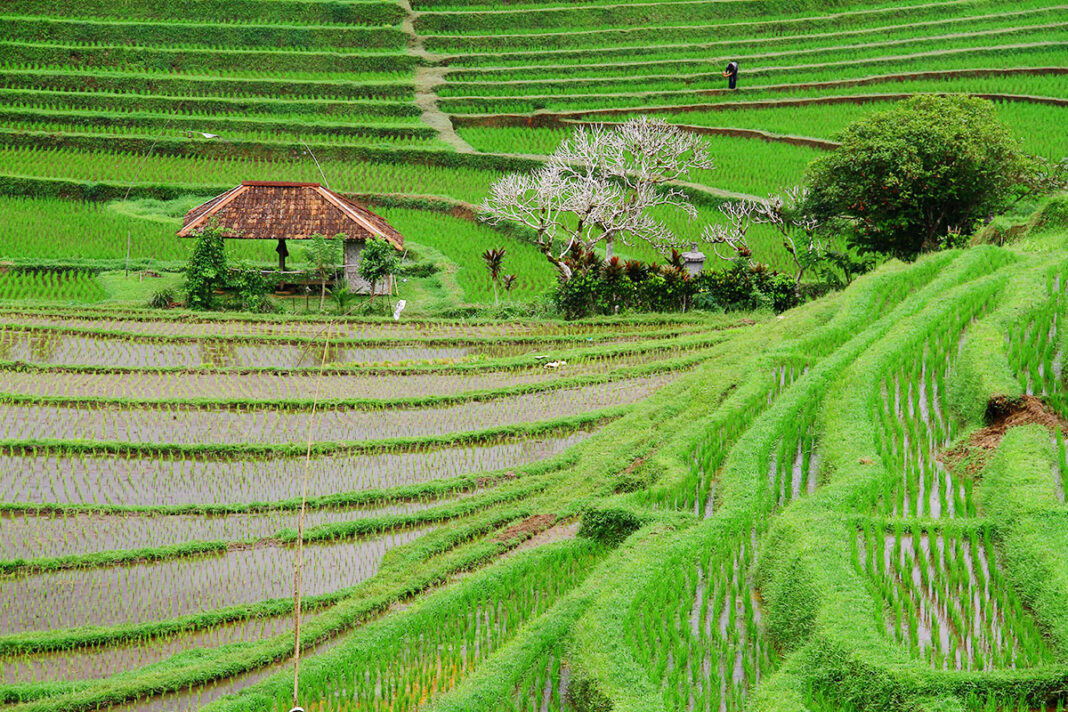
I can’t name one reason why I fell in love with Bali. It was everything together. The green rice terraces and the ocean. The small offerings of flowers on the pavement every morning. People who smile first and ask questions later. And a language that opened its door so easily that within a year I spoke it well.
The language was the key to all of it. When you can speak, even with mistakes, Bali stops being a beautiful picture and becomes a home, with neighbours, friends and long conversations.
The little textbook
Many Russian speakers came to Bali in those years, and most of them didn’t know a word of Indonesian. I wanted to show them how simple, fun and interesting it is. So I wrote a short textbook with everything you need for your first days on the island: how to read, how to count money, how to bargain at the market, how to order food that isn’t too spicy, how to rent a bike and find a mechanic when it breaks.
Recently I went through it again. I fixed old mistakes, split it into eight short chapters and added small exercises and a cheat sheet. The textbook is in Russian and English, and you can download it here for free.
If you’re going to Indonesia, learn a few words before you go. Say them out loud, even with mistakes. You’ll see the smiles yourself.
Sampai jumpa!
Russian Version:
indonesian-za-odin-den
English Version:
indonesian-in-one-day