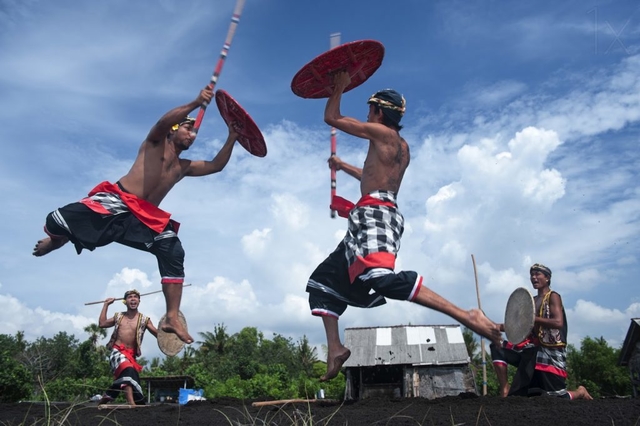
The Balinese have their own relationship with nature. If something is wrong with the weather, you can talk to the spirits and ask them for help. Even the dry season has its own ritual, by the time the farmers are worn out from hauling water for their fields in barrels.
In Karangasem, in October and November, people keep the tradition of Gebug Ende to call the rain. The ceremony takes place in the village of Seraya.
Seraya sits on high ground at the eastern tip of Bali, and Karangasem gets less rain than the south of the island. In the dry season the land here turns dry and bare. So when the rain is late, the village skips the weather forecast and takes up rattan sticks.
In the dry season the villagers hold rattan battles.
Where the fighting spirit came from
The tradition goes back to the days when the men of Seraya were recruited into the army of the Karangasem kingdom to attack the kingdom of Selaparang on Lombok. In those times the people of Seraya were known as strong and hardy, and they were believed to hold valuable knowledge. That is why they marched in the vanguard of the army.
But when Karangasem defeated Selaparang and took control of it, the fighting spirit of the Seraya men would not settle down. The war was over, and the energy was still there. So the villagers began to fight each other with improvised weapons. That is how Gebug Ende was born.
Another version of the story is told too. In it, the Karangasem army won thanks to a heavy downpour, which the warriors took as help from God. They came home to find Seraya in the grip of a long drought, and the fighting game became a way to ask for rain again. Whichever version you prefer, war and rain are tied together in this ritual from the very beginning.
How the battle goes
The ritual opens with prayers and offerings. It is held in Sasih Kapat, the fourth month of the Balinese calendar, before the planting season, and the prayer is addressed to Ida Sang Hyang Widhi Wasa, the supreme god of the Balinese. The fighters usually gather in the fields in the afternoon or evening.
Then come the duels, where the villagers show their skill. Two men fight each other, armed with sticks 1.5 to 2 metres long. They strike the opponent with the stick and defend themselves with round shields. Most descriptions call the shields rattan; some say they are made of dried hide.
The word gebug means “to strike the opponent”, and ende means “shield”. So the name of the ritual is also its full instruction manual.
Fighters are chosen by the juru kembar, the man who leads the bout, by their build and age. Before the real fight he often stages a demonstration bout, swinging at the opponent on purpose without hitting him, just to warm up the crowd. Some participants drink a little tuak, palm wine, beforehand, just enough to warm the body and raise the spirit.
The fighters arrive in traditional Balinese dress, with an udeng on the head or a red ribbon, which is a symbol of the human soul. For the duel they take off their shirts and put on gloves.
The battle is accompanied by gamelan, the traditional Balinese orchestra of gongs and metallophones. The music winds up everyone around even more. The bout lasts several minutes and is controlled by a referee.
The rules are short and clear:
- No strikes below the navel.
- No grabbing or hugging the opponent.
- No stepping over the boundary line to attack.
Break a rule, and the referee separates the fighters and gives a warning. Break the same rule again, and you lose and leave the ring.
Listen to the fight with your eyes closed, and you will hear it the way the Balinese describe it: plak, plak, plak, cebet, cebet. The crowd roars, and the fighters start to dance with excitement right in the middle of the bout.
Blood for rain
The Balinese believe it is better if someone is wounded until he bleeds during the fight. Then, they say, the rain will come soon.
For a visitor the sight can be frightening. Rattan is hard, and the welts on the backs look serious. For the village, every drop of blood on the dry ground is a sign that the sky has heard them. A strange way to ask for water, you might think. But in a place where the wells dry up, people speak to the sky in the strongest language they have.
Old enemies, one ritual
Now the most curious detail. The opponents in Gebug Ende are often invited from neighbouring villages, among them Ujung Pesisi, a fishing village by Ujung Beach. Most of its residents trace their roots to Lombok. So the descendants of warriors who once marched on Lombok now meet people with Lombok roots, and both sides fight with sticks to bring rain to the same dry land.
Lombok has a very similar tradition of its own. The Sasak people call it peresean: two fighters with rattan sticks and shields of cow or buffalo hide, judged by referees, and traditionally held in the dry season to ask the Creator for rain. And the Sasak word for the shield is ende. The same word on both sides of the strait. The kingdoms fought, the borders moved, and the people on both islands kept asking the sky for rain in almost the same way.
Where to see it
The ritual lives on in the village, but you do not have to be invited to see it. In recent years Seraya has held the Seraya Culture Fest, and Gebug Ende is its highlight. The final bouts are open to the public, and entrance is free. Bouts are also staged at Taman Ujung, the water palace near Amlapura. Seraya is about two and a half hours by car from Denpasar.
If you go, stand a little back from the edge of the ring. Rattan swings wide. And maybe bring a raincoat. If the villagers are right, you will need it on the way home.